

Organize By:
Information is growing at an unprecedented pace, and rapid advances in technology are speeding it up even further. Without the right attention, this flood of content can become a serious challenge to how we understand the world and one another.
When too much information goes unfiltered, it opens the door to false information, as the many hoaxes and fake news stories circulating in our media show. Left unaddressed, false information can lead to confusion, distrust, and eventually polarization. Research suggests this concern is real; Katadata, reporting on a 2019 CIGI–Ipsos survey, notes that hoaxes have reduced public trust in the media by 40% worldwide, and that 22% of respondents said their trust in government decreased.
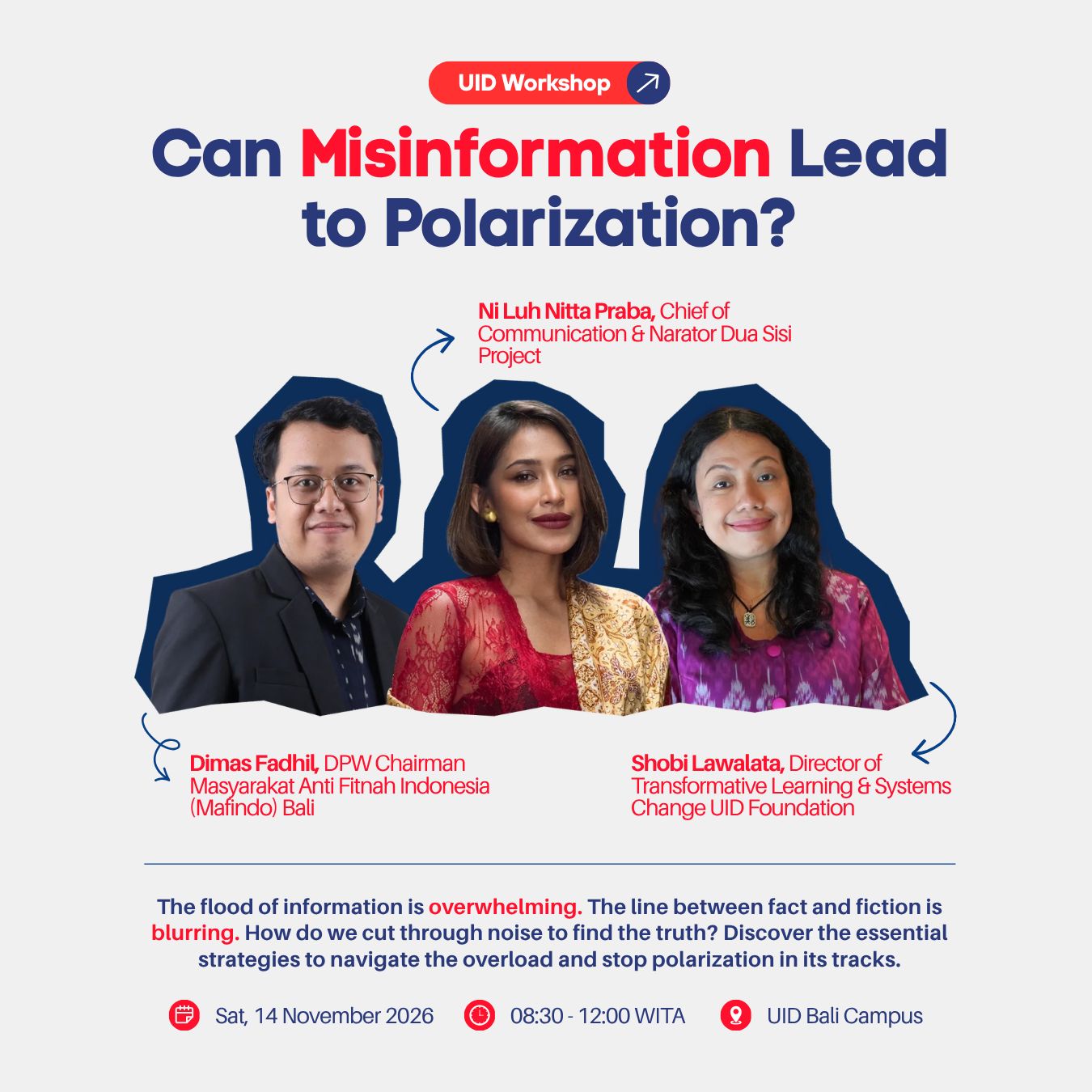
That is why it matters, especially for young people, to be equipped with the skills to identify and analyze this phenomenon. Join us at the UID Workshop “Can Misinformation Lead to Polarization?” to learn about how false information works, practice spotting it, and find out how to tackle it. The session combines expert talks with a hands-on group practice led by a trainer.
Saturday, 14 November 2026
08.30–12.00 WITA
Cloud Lounge, 2nd Floor, UID Bali Campus, Kura Kura Bali SEZ
The event brings together experts from MAFINDO (Masyarakat Anti Fitnah Indonesia) Bali and Dua Sisi Project as trainers and speakers.
What to expect
1. Understanding the different types of false information
2. Learn how psychological factors and cognitive biases shape the way we accept and spread information.
3. Practice recognizing misleading claims, fabricated quotes, and AI-manipulated content.
4. Build the habit of checking the source and context of information before sharing it.
5. Take part in cross-sector dialogue to strengthen trust in information, the media, and public institutions.
Featured speakers
1. Ni Luh Nitta Praba, Chief of Communication & Narrator, Dua Sisi Project
2. Shobi Lawalata, Director, UID Bali Campus
3. Dimas Fadhil, Chair of the Regional Representative Council (DPW) MAFINDO Bali
Who can join?
Youth, young professionals, academics, media practitioners and journalists, representatives of the public and civil society organizations, and representatives of government agencies who are interested in digital literacy, public communication, media, technology, and the challenges of spreading information to the public.
no ticket needed for this event.


-
Category:
Event -
Type:
Offline -
Date:
14 Nov 2026 -
Time:
08:30 AM - 12:00 PM -
Location:
UID Bali Campus